

Your pneumatics are quietly costing you more than you think.
Factories are getting smarter. Production lines are more connected. So why are the systems underneath them still running on assumptions from a decade ago — and what is that gap actually costing your operation?
Kanchan Rajput
Marketing Executive · May 2026
14 May 2026
9 minutes
Pneumatic Engineering
Kanchan Rajput
Factories are getting smarter. Production lines are more connected, gigafactories are scaling, predictive maintenance is replacing reactive repairs, and energy efficiency has moved from the engineering office to the boardroom.
But walk into most facilities and you'll find one part of the operation that hasn't kept up: the pneumatic system underneath all of it.
At SPAC Pneumatic, we work with manufacturers across heavy industry, packaging, battery production, and advanced automation. And we keep seeing the same pattern — production has evolved, but the pneumatics powering it are still running on assumptions from a decade ago. That gap is no longer just a technical issue. It's a financial one.
30%
Of compressed air typically lost to leaks
£12k+
Annual loss from a single mid-size facility
2–4×
Component life extension with proper air prep
0m
Visible warning before a slow-failure cascade
The hidden cost of "background" infrastructure
For years, pneumatics were treated as something that just had to work. As long as cylinders moved and valves switched, no one looked any closer.
That mindset is now expensive.
A small air leak across a single line sounds trivial — until you cost it across 24/7 operation. Poor air preparation quietly destroys valves and cylinders months before anyone sees a visible failure. Incorrectly sized components reduce responsiveness, accelerate wear, and create the kind of inconsistency that shows up as scrap, slow cycles, and missed throughput targets.
None of this looks like a breakdown. That's exactly why it's so costly. The losses are spread across thousands of hours and rarely make it onto a maintenance report. Most plants we audit are surprised by how much compressed air they're paying for and never actually using.
🔧
ENGINEERING NOTE
In one recent audit, a packaging facility was running a 90 kW compressor at near-continuous load. Forty-one per cent of that output was being lost before it reached a single actuator. The fix took two weeks. The savings paid it back inside the first quarter.
"The losses are spread across thousands of hours and rarely make it onto a maintenance report. That's exactly why they're so costly."
— SPAC ENGINEERING, FIELD NOTESModern automation has changed what pneumatics need to do
Manufacturers don't want generic systems anymore. They need pneumatics built around specific operational realities — and the demands are getting sharper.
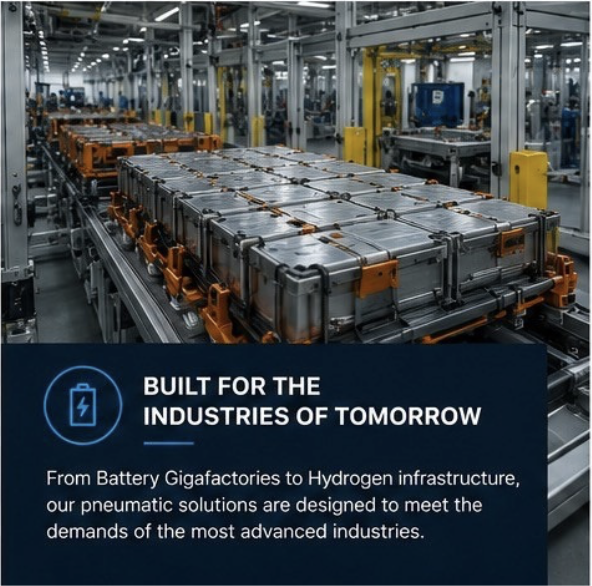
Battery manufacturing is the clearest example. Dry-room environments require components that hold tolerance across millions of high-cycle operations under tightly controlled humidity and contamination conditions. A valve that performs fine in a general assembly plant will fail early in a gigafactory. Hydrogen infrastructure adds its own constraints: material compatibility, pressure stability, and safety-critical sealing across a range of operating temperatures.
This is why we've focused SPAC's product range on pneumatic cylinders, valve systems, and air preparation equipment engineered for advanced manufacturing — not catalogue-spec components hoping to survive in environments they weren't designed for.
In highly automated facilities, consistency matters as much as speed. A line that runs fast but inconsistently still loses to one that runs slightly slower with predictable output. The economics of modern production reward repeatability more than raw cycle time, and that shift is reshaping how pneumatic systems should be specified from day one.
Pneumatics aren't being replaced - they're getting smarter
There's a misconception that pneumatics are being phased out as factories digitise. The opposite is happening. Pneumatic engineering is becoming one of the most actively instrumented disciplines on the modern factory floor.
Today's pneumatic systems integrate technologies that would have been considered exotic a decade ago:
01 /
Pressure monitoring at the actuator level
Real-time data on every cycle, not just system-wide averages.
02 /
Smart valve islands with embedded diagnostics
Faults reported before they become failures.
03 /
IO-Link integration into plant control architecture
Pneumatics sit on the same digital backbone as servo and vision systems.
04 /
Predictive diagnostics on cylinders and valves
Cycle counts, response curves, and drift detection.
05 /
Real-time energy and performance telemetry
Visibility into what every kilowatt of compressed air is actually doing.
The conversation has moved from "does it move?" to "can it tell us when it's about to underperform?" That visibility is becoming a competitive advantage. Plants that catch pressure instability early avoid downtime. Maintenance teams that work from real data solve problems before they cascade. The factories pulling ahead aren't the ones with the flashiest robots — they're the ones whose foundational systems are measurable and reliable.
Energy: the line item everyone is now watching

Compressed air has always been one of the most expensive utilities in an industrial facility. Rising energy costs have pushed it up the priority list fast.
Yet most factories are still bleeding energy through leaks, unstable regulation, undersized lines, and poorly selected components. We've seen single facilities lose tens of thousands a year to inefficiencies they couldn't pinpoint because no one had instrumented the system to find them. When the bill arrives, it gets coded as utilities and absorbed. The root cause never gets investigated.
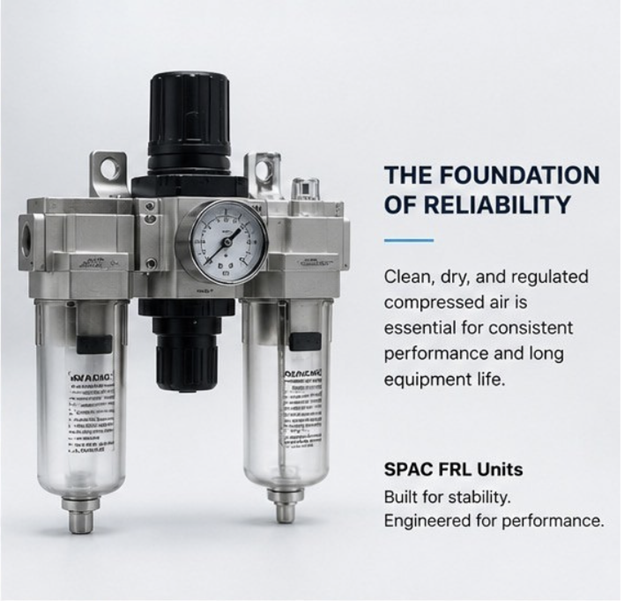
This is why air preparation has become one of the highest-leverage investments in modern pneumatics. Properly designed FRL units and clean, regulated supply don't just extend component life — they stabilise the whole system. Cycle times tighten. Failures drop. Energy consumption falls. The savings compound month after month, and they show up on the P&L within a single reporting period.
📋
WHAT WE SEE IN AUDITS
The biggest automation wins right now aren't coming from adding more technology on top. They're coming from fixing the foundations underneath.
One-size-fits-all is over
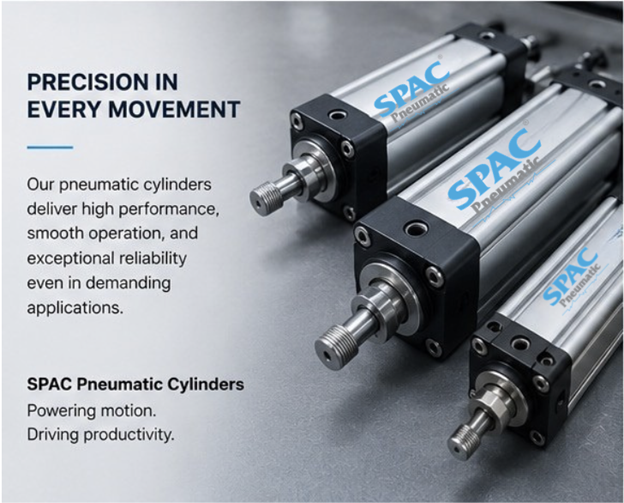
Battery production, hydrogen infrastructure, packaging automation, material handling, advanced manufacturing — these are no longer variations of the same automation problem. They're genuinely different engineering challenges, each with their own failure modes, operating envelopes, and reliability expectations.
That's why application-specific pneumatic engineering matters more than ever. The right cylinder, valve, or fitting isn't just about technical compatibility on a datasheet. It's about reliability over millions of cycles, efficiency over years of production, and performance under the real environmental conditions your line actually operates in — the temperature swings, the contamination, the duty cycle, the maintenance access.
Those details separate systems that function from systems that perform. And in our experience, they're also the details that get overlooked when pneumatics are specified late in a project, treated as a commodity bill of materials rather than a piece of engineering in their own right.
What this means for your operation
The manufacturers winning over the next decade won't just be the ones adding automation. They'll be the ones whose pneumatic foundations are engineered for what their production actually demands — efficient, instrumented, and built for the specific environment they run in.
The good news is that the gap between where most pneumatic systems are today and where they need to be is bridgeable, often without replacing the whole installation. A focused audit, smarter air preparation, properly specified components, and a small amount of instrumentation typically deliver the biggest gains. The investment is modest compared to the recurring losses it eliminates.
The harder problem is recognising the cost in the first place — because, as we said at the start, this is the kind of problem that never quite looks like a problem.
Find out what your pneumatics are really costing you.
Our engineers will audit your existing system, identify where compressed air, energy and component life are being lost, and give you a clear, costed plan to fix it. No obligation. No generic recommendations.
Book a System Audit →↳ Unexplained downtime on automated lines
↳ Rising compressed air or energy costs
↳ Inconsistent cycle times or scrap rates
↳ Pneumatics not specified for current production
↳ Frequent valve or cylinder failures
Tags